Teams doing Google promotion, nine out of ten, get stuck on content.
It's not that they don't know how to build backlinks or how to run ads. The most troubling thing is: they clearly know they need to update the website, write articles, and add product pages, but manpower and time simply cannot keep up. Foreign trade teams are already small in number; operations staff also handle sales, and salespeople have to reply to customer messages. Producing one article a day is already considered high output, let alone updating dozens of product pages in rotation.
But Google thrives on content. It gives lazy sites no chance. If you update slowly, it will crawl your rankings slowly, and even competitors can write a few articles and push you down. At this point, you will repeatedly ponder one question: how to do Google promotion to maintain content frequency without exhausting your team?
The solution provided by the SEO123 content automation system is straightforward enough — use AI for batch generation, use the system for unified site management, and publish with one click.
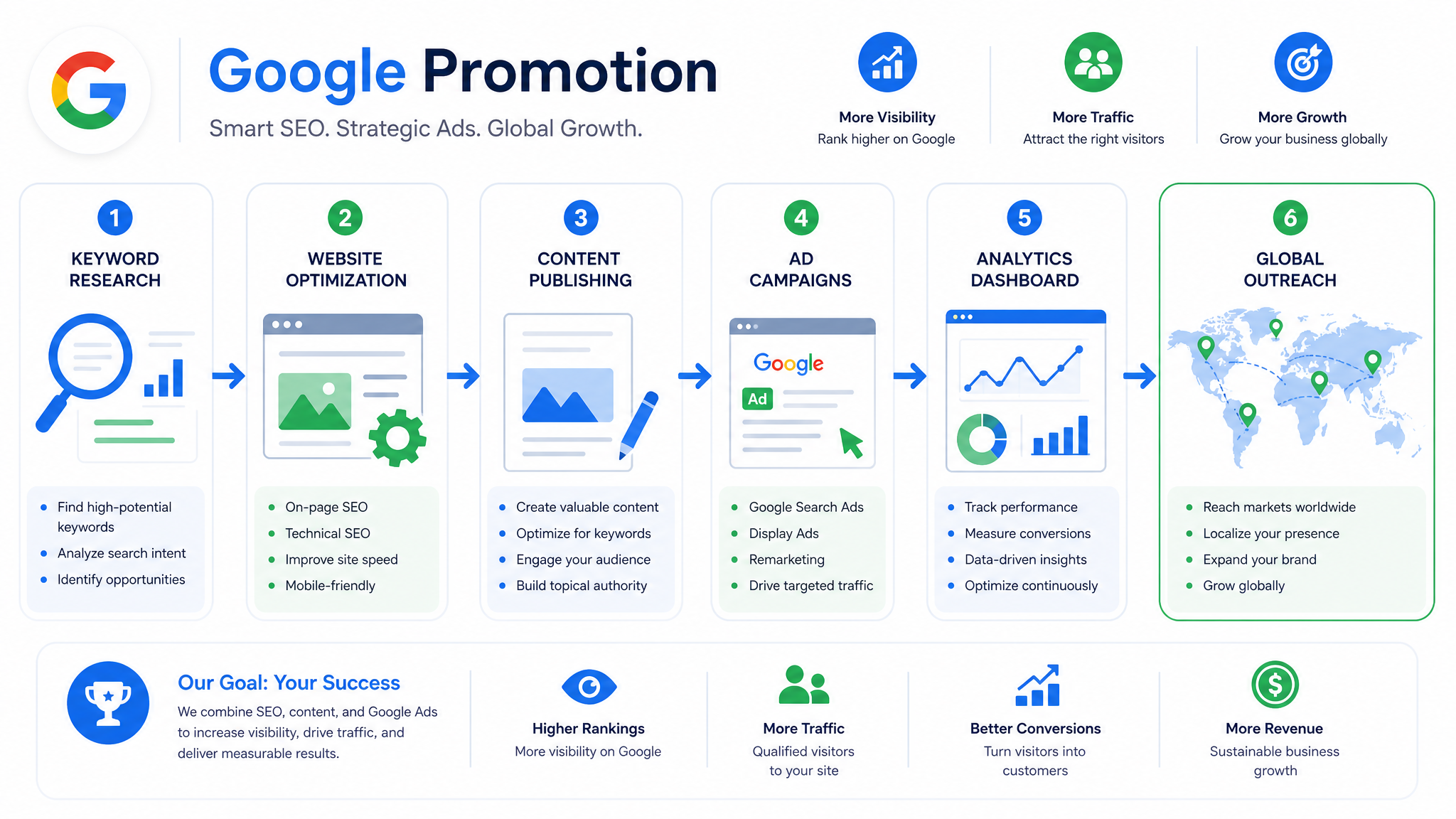
Content efficiency problems, solved by AI
Previously, one person managed one site, writing, formatting, and publishing all manually. Now, let AI create the first draft, and humans only need to review and fine-tune. The approach of SEO123 is batch generation — not slowly polishing one article, but generating dozens at once by topic and keyword pool.
Here's a key point: generation quality. The problem with many AI generation tools on the market is that they 'look like human writing, but lack focus when read.' SEO123 has made product-level optimizations in this area; the generated articles do not stuff keywords, and the paragraph logic is relatively smooth. In actual tests, using it for product description pages, FAQ sections, and industry educational articles has yielded stable results.
For example, a client in mechanical parts needed to add page descriptions for 300 SKUs on their English site. Pure manual writing would take at least a month. Using SEO123 with templates for batch processing, the first draft was done in five days, leaving only checking and parameter replacement. This directly determines the website's indexing volume and long-tail keyword coverage speed.
Real-world scenario of multi-site management
People in foreign trade often have more than one site: the main English site, multilingual sites, brand independent sites, and even sub-sites for different product lines. In the past, each site had its own backend process, with content being republished repeatedly, making operations a nightmare.
The 'unified management' design of SEO123 is clearly valuable in this scenario. All sites can be viewed in one backend, content can be distributed targeted or broadcast with one click. What is saved is not just one or two steps, but the hidden cost of switching between systems.
An agency team reported that they manage 8 foreign trade sites. Previously, just distributing content took half a day each week: switching accounts, copying and pasting, checking formats, and they would often miss one or two sites. After switching to SEO123, they write the content, select the sites, and push once, compressing the time to within half an hour.
Boundaries of applicability and inapplicability
SEO123 is obviously not an all-purpose tool. The scenarios it fits have very clear boundaries.
Suitable for: pages with high content volume, high update frequency, and not requiring exceptional creativity. For example, product descriptions, industry FAQs, basic educational articles, and news summary content. For these pages, Google values coverage and information density, and AI generation is fully capable.
Not suitable for: articles that require high authority, deep industry insights, or exclusive viewpoints. For example, white papers, in-depth industry analyses, and original case studies. Such content still relies on human writers, with AI only assisting in organization.
Another thing to note is that AI-generated content needs human review. Keyword density, factual accuracy, and brand tone are aspects that machines cannot fully control. SEO123 provides efficiency and basic quality, but the final judgment remains with humans. If the team completely abandons the review process, content quality will visibly decline over time.
Also, if you are running a Chinese site for pure Google SEO, SEO123 is equally applicable. It is not limited to English content. Multilingual sites can also use it, but you need to confirm whether the generated language quality is sufficient.
Back to the matter of Google promotion
In the end, there is no magic to Google promotion. If content is well-placed, link building follows, and site structure is fine, rankings will naturally rise. And the core difficulty of the question 'how to do Google promotion' is often that the content leg is not long enough. The SEO123 content automation system solves this leg problem—it allows you to increase content volume and reduce management costs with limited manpower.
If your current content output speed is holding back your rankings, you can try this automation path. You don't have to do it all at once; first run one site for a month, observe the changes in index volume and ranking keywords, and then make a judgment. It is indeed a notch higher than purely manual grinding for efficiency.
Comments
Leave a Comment