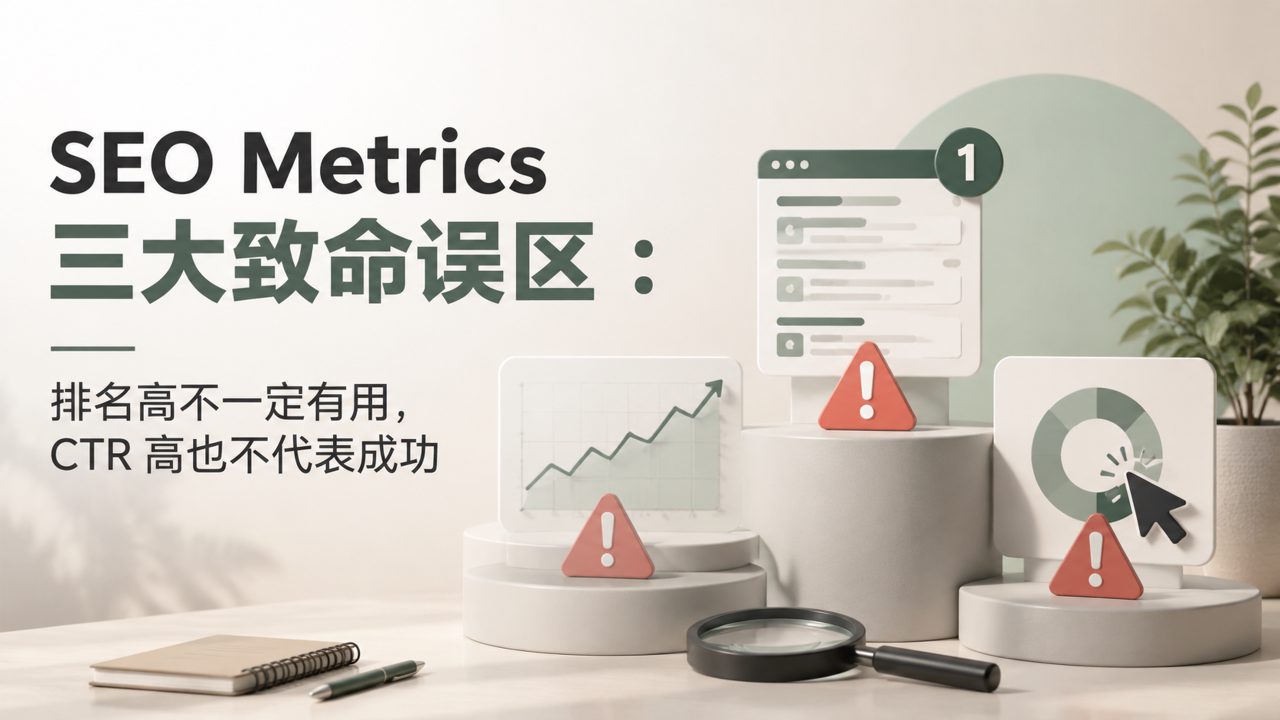
People who do SEO face SEO Metrics almost every day. But to be honest, many people's approach is wrong from the start.
Some people stare at impressions every day, thinking that an increase in exposure is a victory. Others obsess over accurately tracking every traffic change, spending energy on distinguishing direct from organic. And then? The content hasn't changed, the direction hasn't been adjusted, and three months later, it still drops as it would.
Today's article won't talk about how to improve rankings; instead, it will focus on the common pitfalls when looking at SEO Metrics. Especially when you start using automated systems like seo123 to manage sites in bulk, the more data you have, the greater the chance of misjudgment.
Misconception 1: Treating "Ranking" as the Only Truth
Many site owners have made a mistake — when a keyword jumps from page 40 to page 3, their first reaction is jubilation. But "ranked" in SEO Metrics only tells you that the search engine has indexed your page; it doesn't mean anyone saw it.
I've seen the same situation on several client projects: a long-tail keyword ranks in the top 5, but its monthly search volume is only 10. No matter how high the ranking, it contributes almost nothing to the business.
The more fatal problem is that you may be kidnapped by this false sense of achievement, tilting all optimization resources toward those "nice-looking but useless" keywords. Real SEO Metrics should make you focus on the combination of ranking and click-through rate, not an isolated number.
Misconception 2: Looking at Heatmaps Too Much Leads to Misjudging User Intent
The CTR data in Google Search Console is a core basis for many people to judge page quality. But there is a hidden trap here — high CTR does not necessarily mean user satisfaction.
For example: A client of mine created a "SEO tool comparison" page with a CTR as high as 8%. But the bounce rate was over 90%, and the average time on page was less than 15 seconds. What does this show? The title was too enticing, but the content didn't meet the user's actual needs.
Users click in and find it's not what they wanted, then leave immediately. CTR in SEO Metrics is just an "indicator of attractiveness," not an "indicator of problem-solving ability."
What you really need to look at is whether the page's bounce rate and engagement are stable after you use AI to generate content in bulk. This is also why in systems like seo123, besides ranking data, the pages you should pay more attention to are those where "users clicked in but didn't click again."
Misconception 3: Only Looking at Site-Level Data, Ignoring Page-Level Issues
Many SEO tools pile metrics on dashboards: total traffic, total impressions, average CTR. They look nice, but are practically meaningless.
The real problems are often hidden at the individual page level. Take a cross-border site as an example: site-wide traffic grows 15% monthly, looks great. But upon closer inspection, the homepage accounts for 80% of traffic, while dozens of other product pages have almost zero exposure. Under such an imbalanced structure, any optimization action must be very cautious.
If you blindly adjust your content strategy based on site-level data, you will likely make the good better and the bad worse. This is also the most common pitfall for 80% of people doing SEO matrix — they see total traffic increase and think the system is fine, but in reality, most pages are "swimming naked."
When using matrix systems like seo123 to generate content in bulk, I recommend that you regularly pull a "zero-traffic page list" and evaluate them individually. These pages either have subpar content quality or entry issues. Leaving them unattended is just wasting your crawl budget.
Misconception 4: Ignoring the "Business Relevance" Behind the Data
SEO Metrics are essentially just numbers, but what do they actually reflect? Many people don't get it.
For an e-commerce site, a keyword ranking 3rd has a conversion rate of 0.01%; a keyword ranking 30th has a conversion rate of 0.5%. If you only look at SEO Metrics, you would cut optimization investment for the latter. But the business tells you that the latter is the real purchase-intent keyword.
Therefore, judging whether a system or tool is good is not about how many dimensions of data it shows you, but whether it can help you connect SEO Metrics with business goals.
Metrics that allow you to quickly identify "which pages are wasting resources" are actually more useful than "how much total traffic has increased." You will feel this more deeply if you start doing AI-driven SEO matrix — the larger the amount of data, the more you need focused signals, not noise.
Summary: Shift Attention from "Numbers" to "Judgment"
Whether you use traditional methods or rely on automated systems like seo123, the core value of SEO Metrics is never to let you know "what happened," but to help you answer "why it happened" and "what to do next."
Data itself does not lie, but the interpretation can. Avoid these 4 pitfalls, and your optimization efficiency will at least double.
Comments
Leave a Comment